
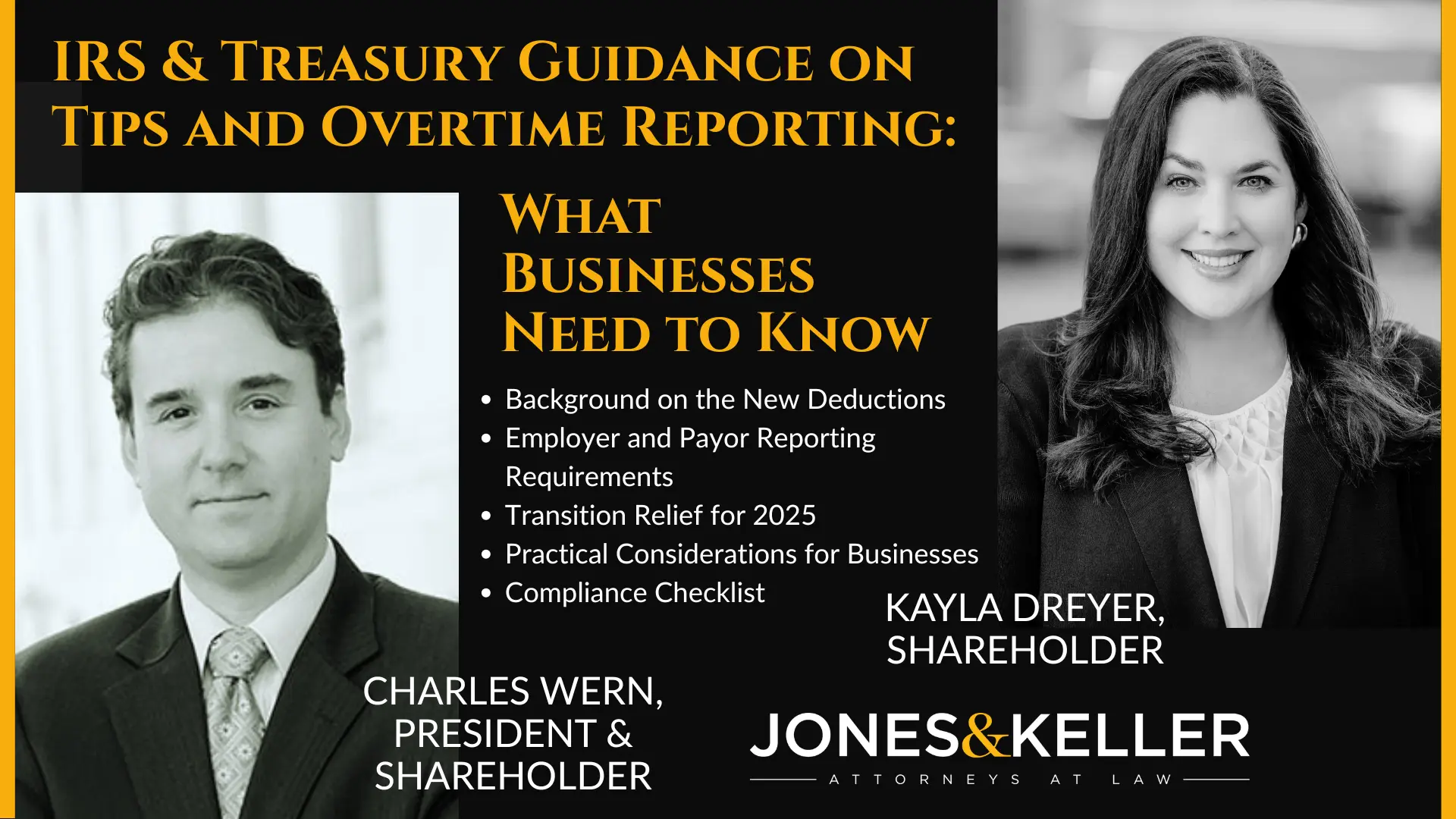
New Payroll Reporting Obligations for Qualified Tips and Overtime Compensation Beginning 2026
The IRS and U.S. Treasury have issued guidance to businesses for implementing new tax deductions for qualified tips and overtime compensation created under the One, Big, Beautiful Bill Act (“Act”). While the IRS and Treasury have granted employers transition relief for 2025, businesses will have new payroll reporting obligations beginning 2026 and should prepare for the change.
Under the Act, deductions are available for qualified tips and overtime compensation for tax years beginning after December 31, 2024 and ending before January 1, 2029.
Individuals may deduct up to $25,000 annually in qualified tips, subject to income phase-outs for taxpayers with modified adjusted gross income (AGI) up to $150,000 ($300,000 for joint filers). Qualified tips include cash tips, credit/debit card tips, gift cards, casino chips, and mobile app payments denominated in cash. Tips received under mandatory or voluntary tip pools are also eligible. To qualify, tips must also (a) be paid voluntarily, not negotiated, and determined by the payor (thus, for example, an automatic restaurant charge added for large parties, with no option to modify or disregard the charge, is not a qualified tip, but amount above that automatic charge would qualify); (b) received in an occupation that customarily and regularly received tips on or before December 31, 2024; and (c)_not received in a Specified Service Trade or Business as defined under IRC §199A (e.g., health, law, accounting, performing arts, consulting). Digital assets, non-cash items, and tips related to illegal activities are not qualified tips subject to deduction. This deduction is an “above-the-line” deduction, meaning it is subtracted from gross income to determined AGI whether or not the taxpayer itemizes or takes the standard deduction.
Individuals may deduct up to $12,500 annually (joint filers: $25,000) of qualified overtime pay, subject to the same income phase-outs for qualified tips. Qualified overtime means pay required under Section 7 of the FLSA (time-and-a-half for hours over 40/week). Overtime paid in excess of FLSA overtime laws, as under state laws or collective bargaining agreements, are not deductible as qualified overtime. This deduction is also an “above-the-line” deduction.
Beginning tax year 2026, businesses must include on tax returns a separate accounting of amounts designated as cash tips and the occupation of the recipient of the tips. For non-employees, tip amounts and the worker’s occupation must be included on Form 1099. The IRS is expected to update Forms W-2, 1099-NEC, 1099-MISC, and 1099-K for tax year 2026 to comply with the Act.
Importantly, employers are prohibited from reclassifying wages as tips to inflate deductions for workers, with the Treasury expected to be issuing anti-abuse regulations imminently.
In addition, the IRC §§ 224 and 225 deductions for qualified tips and qualified overtime do not exempt those amounts from payroll taxes (i.e., Social Security and Medicare, also known as FICA and FUTA taxes). Qualified tips and overtime remain subject to these payroll taxes and related withholding requirements for both employees and employers, and therefore employers must still withhold the employee’s share of FICA and FUTA taxes from all reported tips and overtime and pay the employer’s matching share.
Businesses are not subject to penalties for failing to report tips and overtime under the new rules in 2025. However, employers may approximate separate accounting by any reasonable method to assist employees with reporting tips and overtime. The IRS has encouraged employers to provide occupation codes and separate accounting of tips and overtime voluntarily and include overtime info in Box 14 of Form W-2 or a separate statement.
To comply with their reporting obligations, businesses should continue collecting employee tip reports and maintain overtime records per FLSA and state and local law. As a reminder, employees must keep a daily tip record, report all tips on their individual income tax return, and report to their employers in writing their received tips each month, due on or before the tenth day of the following month.
Employers should also prepare their payroll/HRIS systems and independent contractor payment processes for 2026 to capture tips and overtime separately. It is also imperative that Human Resources and payroll staff understand the employer’s obligations and anti-abuse regulations to streamline operations during the transition.
The IRS has provided transition relief for 2025, but significant reporting changes take effect in 2026. Early planning will minimize compliance risks and ensure smooth implementation. Jones & Keller employment and tax attorneys are available to assist businesses in complying with these new requirements or answer any questions that you have. Reach out to Charles Wern or Kayla Dreyer for guidance.
Jones & Keller, P.C. is a full-service business law firm with Denver roots and an international reach. The experienced and award-winning lawyers at Jones & Keller are trusted advisers to some of the most sophisticated individuals, entities and enterprises across the globe. Visit JonesKeller.com.